Sunday, December 11, 2011

Neuquen: Bones, candied strawberries and a crazy porteno

While in Mendoza, we realised that our ever careful planning had a slight faux pas. We had about two days to spare even after hitting all that we wanted to. On the lookout for novelty and surprises we decided to head for the paleontological wonderland of Neuquen.

A sleepy, little town, Neuquen has little to do except visit the dig sites and museums around it where lie a plethora of fossils. Thanks to rich sedimentary rock formations at the site of a water body which receded, there are enough fossils for you to practically crunch underfoot. Neuquen's moment in the sun arrived when the bones of largest carnivorous dinosaur (the aptly and imaginatively named Gigantosaurus Carolinii) were discovered here.

We hopped on to an overnight bus from Mendoza, on which we were promptly offered a rather ham-y "vegetarian" lasagna for dinner, and arrived bright and early to find no one who could understand our broken Spanish. Finally, we were aided by a lady at a car rental booth, who spoke a smattering of English and was kind enough to excuse the brutally murdered local tongue. She pointed us to a hotel in town, told us where to go and find out more about the dig visits. The hotel we decided upon looked neat and clean from the outside and for the most part was pretty clean but seemed to be run by a clutch of grumpy, old ladies who seemed set on scowling the joy out of you.

We of course set out for lunch in the middle of siesta, but managed to locate a cafe with a warm and gregarious waiter, who insisted on repeating whatever we said punctuated with a si at roughly five times the decibel level. Some rather large humita and spinach empanadas made for lunch. After this, we headed straight to the tourist office in Neuquen to inquire about trips out of town. At this point, we must commend their patience since we went back repeatedly for various bits and pieces of information that we thought about after leaving the office (also, they spoke English! Hallelujah!) before we were fully satisfied. After gathering everything and speaking to a couple of agents we landed at the offices of Quantum Tours to meet the mind-boggling Pablo Daniel Gonzalez.

Pablo speaks in rapid, loud and expressive Spanish regardless of whether you understand it or not or even have a chance to respond much. Pablo wants to know everything about you and he laughs a hearty laugh every time he feels like it. Especially when he knows neither side understood what the other just said. Pablo was overjoyed that our last stop was going to be Buenos Aires, since he is a porteno. Pablo highly recommended our next stop, San Martin de los Andes, and said that it was muy muy muy muy muy (lost count after a while) muy lindo. He also insisted on an "OK" based rating system for hotels there. There were a few which were "OK OK OK OK OK ... OK" but muy caro. There were a few which were barato but just "meh". And there were a couple which were "OK OK OK" and apparently reasonable. Pablo made no promises but still got us a room at one of these. Pablo also got us the best rate for a cab to Proyecto Dino, an active dig, and warned MFTree to keep an eye on me 'cause there was going to be a woman driving it. Pablo is awesome.

As promised, we set off early next morning with the cheery Reina at the helm of our cab. Driving through some stunningly desolate and rambling red-sand-and-stone scenery, Proyecto Dino was upon us, on the banks of the Lago Barreales. After the initial welcome by a sunny Italian researcher, dressed like a twenty-first century Indiana Jones, we were passed on to our guide - a travel-industry trainee nervously eager to show around her first tourists. The project has a fairly neat demonstration of fossil formation and some garish neon-coloured plaster of paris models.
Along with that we were upon some real-
life archaeologists mucking around with their spades and brushes around a rather large looking, emerging skeleton. The site also has a slightly decrepit but fascinating museum containing fossils found around the area - ranging from the Gigantosaurus to dinosaur eggs. Our lunch had been arranged at one of the local wineries (of course) - it was delicious (of course) and led to a winery tour and tasting (of course!) The lazy afternoon was completed with a visit to an idyllic little picnic spot where the locals were hell bent on fishing with makeshift lines.

We headed back to Neuquen to spend a couple of hours at the local annual fair. We'd roamed around it the previous evening as well and tasted the most delicious candied strawberries (shame on you candied apples, you pretender, you!) We pigged out on some more of those, learned how they were made, bought some accessories for MFTree and made our way to the bus station to catch our ride to San Martin de los Andes. It is muy muy muy muy muy lindo or in Pablo-English - OK OK OK OK OK OK!

Friday, September 2, 2011

Uspallata, or What-did-you-say?!


Us: "Quisiero dos boletos para 'oospayata'" (I
would like two tickets to Uspallata)
Bus counter lady: ¿Que?
Us: "Quisiero dos boletos para 'oospayata'" (I would like two tickets to Uspallata)
Bus counter lady: ¿Que? ¿Donde?
Us: "Oospayata"? (Uspallata -hurriedly consulting phrase book)
Bus counter lady: ¿"Oospayata"?
Us: ¿Si?
Bus counter lady: ¿"Oospayata"?
Us: *Showing guide book and pointing*
Bus counter lady: Ah, si! Upashaata! Si!
Us: Huh?! But but but, it's spelt Us-pa-lla-ta. Double l pronounced "y" like we thought, no? No? Ok. Double l pronounced "sh" then. And what about that s? Swallow it?! Alright!

Our quick education in the Argentine accent was at the bus stop in Mendoza. We were fumbling around trying to buy tickets to a little valley town in the Andes called Uspallata. The bus folks didn't seem to understand what we were saying until we showed them the name written down. Then it dawned on us that we were a bit off! We came away with slightly bruised egos since we thought our Portuguese and Spanish was now passable enough to at least buy tickets. But we proceeded to have a very amusing time by randomly shouting out Andehmar (Andesmar) and shaama (llama) and Ahtor (Astor) Piazzola!

Soon all confusion was sorted out and we had two tickets for a bus early the next morning to Uspallata, and another bus from there on to Puente del Inca ("Bridge of the Incas") and back. The ticket operator assured us that the only bus back left at 7:30 pm. We shrugged, it didn't really matter to us what time we came back. Little did we know ...

So we set off early the next morning and reached the picturesque little town of Uspallata, where we spent a couple of hours walking around and waiting for the connecting bus to Puente del Inca. Uspallata is located in a valley, in the midst of meadows with the barren, wind-swept, snow-capped Andean peaks ahead. We sauntered across town, had coffee at an old lodge with an ancient looking wooden bowling alley and our packed breakfast sandwiches. After ogling the scenery a bit more, we boarded the next bus to Puente del Inca. The drive was extraordinary! We had front row panoramic view seats, and the narrow road (which eventually goes into Chile) curved upwards through the Andes. We couldn't get enough of the mountains.

As soon as the bus door opened at Puente del Inca, the loud wind whipped inside and chilled every bone in every living things there was.
It was freezing cold. And loud. And hard to concentrate. The bridge itself is a marvelous thing, naturally carved out of rock, with a sulphur hot spring beneath it. Beneath the stone formation is a little spa which had to be abandoned due to structural instability. Abandoned train lines stretch into the distance adding to the lonely and desolate landscape. Snow-capped peaks tower above, shorn of trees and often even grass, leaving dry and dusty slopes with jagged rock formations. Unfortunately the bone-chilling wind soon caught up with us and we proceeded to have some hot coffee and sandwiches. Indoors!

After a brief pause, we made inquiries as to how far we would have to go to get a glimpse of
Aconcagua - the highest peak in the Americas. Discovering that Aconcagua National Park was only three kilometers away, we started off for it, throwing on whatever warm clothes we had with us and braving the still biting wind. Fortunately at least the sky was clear and the sun was out, otherwise it could have been worse! We made slow progress towards the park, stopping often to admire the landscape and click photographs. The base of the park itself has a little loop leading to a viewpoint offering breath-taking panoramic views of the range around Aconcagua. The top of the big one itself was obscured by clouds but that made the scene no less stunning, and this was just the start of our time in the Andes. We were thrilled!

Quickly though, there was a dampener on our elation. Just as we were about to make our way back to Puente del Inca we saw a bus from our company whizz by around 5:30. We were a little bewildered because they had assured us that there were no buses back till 7:30! And we were too far away to flag it down. Well, we thought, maybe it's going somewhere else and continued trudging back to Puente. We reached to find almost everything shut! There was hardly a place to sit indoors and the sun was setting with no let up in the wind, making it even colder than before. There was no response at the one hostel around and the only cafe was winding up. We finally found an old fellow whose living room also served as a restaurant (or was that just his two little dining tables?!). It seemed shut but he invited us in and offered us a pizza, which is all he had. We were ravenous and dug in. We broke open a bottle of wine that we happened to have on us, and the meal wasn't too bad! There was also a television blaring an old Argentine movie, with what seemed to be gaucho-like characters. It was reminiscent of 1970s Bollywood and was about a downtrodden guy and a landowner with some sort of romance thrown in. Very melodramatic! Even though we didn't understand a word it was thoroughly enjoyable.

Our bus finally arrived and we gratefully clambered in, out of the cold, dozing all the way to Mendoza after a full and rewarding day.

(P.S. The rest of our photographs from Mendoza are here)

Wednesday, August 31, 2011

Mendoza - wine tasting amidst the Andes!

From Cordoba we made our way South-West to the town of Mendoza, an epicurean delight, especially for oenophiles! Mendoza is the wine capital of Argentina especially for red wine. (Salta is the capital of Argentina's white wine - it's further North, and we didn't manage to make it there on this trip, but next time for sure!)
Mendoza looks a lot like an affluent town in the Bay area, think downtown Palo Alto. However, the reason one must visit Mendoza is not Mendoza itself, but Maipu, the wine growing region about an hour's bus ride away.

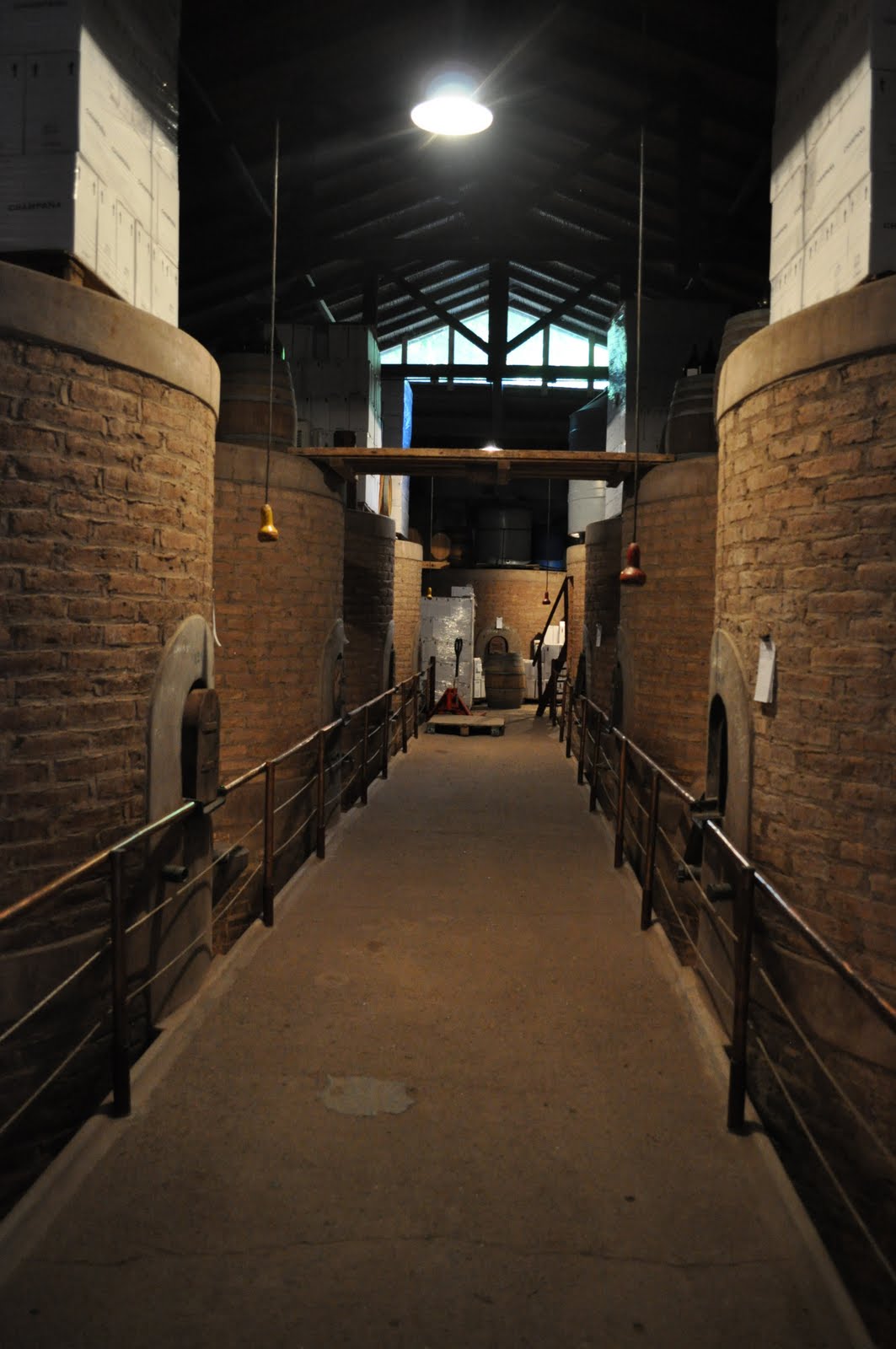
We arrived in Mendoza in the morning, after an overnight bus from Cordoba. Based on Lonely Planet's recommendation, we took a taxi to a hostel called Damajuana, but found it to be above our budget for the day, although it was a lovely place! We walked along till we found a hostel we could afford, although it was considerably less lovely (Hostel Itaka). The only saving grace was our first view of the lower Andes from our window!
We caught a local bus to Maipu and were deposited on a little dusty road in an hour. Renting bicycles is the best way to go wine tasting around here, since most of the vineyards are located along a long stretch of road, and there is no other mode of transport. We started off from the "town" of Maipu and within a few minutes had to whip out our camera to capture our first breathtaking view of the snow capped Andes.


This afternoon was one of the highlights of our trip. Bicycling along a tiny road, surrounded by gorgeous mountains, tasting wine and great food at the vineyards, it was true decadence South America style!


Mendoza is famous for its Malbec, and Tempranillo (pronounced Tempra-neesho). The wine tasting experience here was very different from Napa or Sonoma in California.

It's extremely chilled out, and not as modern or industrialized. It's what I imagine Napa might have been like in the 1970s (here I must confess that my knowledge of Napa in the '70s is based solely on the movie "Bottle Shock").


The vineyards are small, and the family that owns it usually hangs out and talks to their visitors. We lunched at the elegant Tempus Alba vineyard, an absolute paradisical venue, with gifted chefs and winemakers! We bicycled onwards and stopped at the vineyard of the Familia Di Tomasso. We drank plenty of Malbec, tasted our first Tempranillo, and bought a couple of bottles to go with dinner back at the hostel. A small note - the white wine of this region was also quite delicious, although Salta's Torrontes is more famous.


We took a day trip to see Puente del Inca and Uspallata on our second day in Mendoza (see separate post). On our third day we strolled about Mendoza itself, had a long lunch at a nice restaurant just outside our hostel, lazed about in a large park, and discovered the wonder of humita empanadas (roasted corn and cheese filled Argentininan dumplings) just before boarding our overnight bus to Neuquen.

Sunday, April 24, 2011

Pictures from Brasil

The last time we posted a few albums we said that photos from the rest of the trip would be coming up shortly. Well, we know it's been a while, but we finally got around to putting up the rest of our pictures from Brasil (and a tiny bit of Argentina). Rest assured, they're worth the wait! Also, more posts and pictures coming soon!


Sao Luis (Oh Sao Luis, we poured our scorn on you but really all we wanted were some beautiful snaps)


Cataratas do Iguasu - so overwhelming that Foz do Iguasu had to be divided into two parts (I and II) and that's not including the Argentine side!

Friday, January 7, 2011

Cordoba

Argentina's second biggest city is home to seven universities. Besides being young, vibrant, fun, it is an important intellectual and cultural hub. I personally also wanted to visit Cordoba to see the hometown of Alberto Granado, Ernesto 'Che' Guevara's buddy and travel companion on his adventure through South America, chronicled in the book and movie 'Motorcycle Diaries'. I strongly urge anybody who hasn't watched this movie to do so..immediately!We reached Cordoba after a 24 hour bus ride from Puerto Iguazu. We were given the best seats on the top deck of a luxurious double decker bus - the front ones, with a gorgeous panoramic view. We were served hot vegetarian meals as requested, sparkling wine, red wine, coffee, snacks, and a generous dose of hilariously bad Hollywood films dubbed/subtitled in Spanish (2012, Twilight, or Back-Up Plan in Spanish anyone?). That's how I learned my first few swear words in Spanish. We were really spoiled!

Arriving in Cordoba, we were immediately struck by how many "panaderias" (bakeries) there were in town, and the fact that everybody drinks mate. Shopkeepers at work, passengers waiting for a bus, friends taking a walk, students doing homework, an old lady on a sidewalk. Mate was ubiquitous. Naturally, we couldn't wait to try some ourselves. Our first experience with mate was "mate cocido", which is essentially mate in a tea bag, which tastes sort of like green tea. Naturally, I was under-whelmed. But the whole point of mate is in the preparation of the pot, the leaves, and the communal sipping from a cup and straw. We didn't get to experience this until much later when our travels in the deep South of Patagonia got us to befriend a native Cordoban. Lonely Planet had told us that when an Argentinian offers you mate, you never refuse. It's an honor, and an invitation to be their friend. The mate culture runs deep in Cordobans, and families will sit around in the evenings to chat, passing around a mate cup. And students in college will study together, passing around a mate cup.

Cordoba was our first brush with the phenomenon of siesta. We arrived around 11 AM at the bus station, spent an hour planning our next leg of the journey (which bus to take out of town etc.), walked the half hour to the hostel we had selected from Lonely Planet, checked in, showered, washed our clothes (we were running out!), and finally set off to have lunch. To our dismay, everything in town was closed shut. Starving, and bereft of much Spanish, we pointed our way across town and finally reached a strange restaurant run by a old waiter. The food was bad, but it was food. We quickly realized that vegetarian restaurant food in Argentina was going to be pizza or pasta, and that we had left the land of sucos (fresh fruit juices of innumerable flavors) behind when stepped across the international border. However, there were naranja jugos (hoo-goes) to be had! Literally, fresh squeezed orange juice.

The next day was spent walking around town, particularly, the University of Cordoba campus, the Palacio Ferreyra (an art museum) and the Parque Sarmiento, a beautiful large green space in the middle of the city. We ended the day of exploring with a free guitar orchestra performance by a bunch of high school kids in the Paseo del Buen Pastor, a beautiful free performance space. Dinner was fairly bad ravioli with our first bottle of Mendozan Malbec!


The next day we took a bus out of town to the hometown of Alberto Granado, Che Guevara's travel buddy. The sleepy little hill side town of Alta Gracia was gorgeous. However, it was a municipal holiday and so everything was shut. We took pictures of Che's house from the outside fence, and ate empanadas at a tiny restaurant run by a very friendly Cuban couple. We also chanced upon large old mulberry trees and MFTree (reminded by the mulberry trees in her primary school in New Delhi) spent considerable time plucking handfuls of mulberries and eating them straight off the tree! Our sneakers were a royal purple mess as we walked away from the trees.

We left Cordoba to go further south to the Andes, and go wine tasting in Mendoza!

p.s: Cordoba is the capital of Fernet consumption in Argentina, but we didn't end up having any here. As an aside, San Francisco is the Fernet capital of the US! (where most of it is consumed)

Wednesday, December 1, 2010

Cataratas do Iguasu, and Day 1 in Argentina

Foz do Iguasu - our last stop in Brasil. It made us a little sad to be ending the first month of our travel and leaving Brasil where we had been treated to so many good things. We were sad to be leaving the food and great company of Sao Paulo, the lush sights and sounds of Salvador, the vast expanses of Amazonia and Lencois Maranhenses and the history and sadness of Ouro Preto. But all the same we were more than excited about the famed falls and our upcoming Argentine sojourn. We left Salvador on the same taxi as a German couple ending a ten month trip to Latin America and flew to Foz.

We stayed at the neat, clean (although our room was tiny) Hostel Bambu. We were led to it by a Brasilian tourist from Recife who was just returning from a visit Europe and oddly enough got cheap tickets in and out of Foz. Previously having lived around the area for a number of years, oddly enough he had not seen the falls. He informed us that in a one month trip to Europe he had taken nine thousand photos (oddly enough - thought we because we conservatively calculated that he took a photo every 3 minutes assuming he slept for 7 hours a day and showered/ate for an hour a day.) For the purposes of this blog we name him - Oddly Enough. But he led us the right way and we plonked ourselves down in the Hostel and had a terrible pizza for lunch which quickly made us run to the supermercado for supplies for dinner.

At our dinner cookout, we made the acquaintance of a number of engaging travellers. A. an Italian girl living in London, S. an Australian of Italian origin and J. a Kiwi working in Canada for a couple of months. We even bumped into S. again later in our journey. Of course we were kept oddly entertained by Oddly Enough.

The following day was reserved for two things - the Brasilian side of the falls and a bird park just outside the national park. We didn't intend to be at the bird park for long but it was engaging and held us there for the entire morning. Hard to see in the wild unless you have plenty of time - they had a number of birds from around Latin America including toucans, macaws, parrots, cranes, geese and flamingoes among others. They have recreated a number of environments found around the continent - rainforests, wetlands, savanna - and visitors can walk through a variety of them and see the birds up close. At the end of course, you can get a picture with a macaw on your arm!

The afternoon was spent at the main event - the falls themselves. Needless to say they are stunning. As any guidebook will tell you, the Brasilian side gives you a good overview of the falls while the Argentine side lets you get up close and intimate. Vast torrents of water gush down the numerous falls. We walked down a trail and a series of pasarelas (walkways) - past the initial section of the falls from where we could see the Argentine side and the initial section of the falls, past a small island (Isla San Martin) in the middle of the river, watched a speedboat from the Argentine side ferry thrill-seekers to be almost under some of the falls and finally reached the roaring savagery of the Garganta do Diabo (The Devil's Throat.) Probably the most famous section of the falls, this spectacle is not even visible from a distance since it is hidden behind a layer of spray and mist, one can only hear an awesome roar. The Brasilian side has a walkway constructed right to the edge of the Garganta which goes past a huge sheet of a fall and leaves you near the middle of the Garganta. Wet and cold, we thoroughly enjoyed ourselves and were suitably awestruck and amazed. We spent hours staring at the falls from all sorts of angles and places and just couldn't get enough. To be cliched but right, words certainly cannot do justice to the falls and they have to be experienced. There's not much we can write to describe the waterfall with the second highest flow rate in the world plunging down a peak height of 82 m split into 275 different cataracts. We hope some of our pictures will entice you enough to go yourself.

Our last half day in Brasil was spent at the massive (second largest in the world) Itaipu dam - a joint project of Paraguay and Brasil. We took a brief tour around the outside of the dam and the magnitude is striking. The project is second only to China's Three Gorges Dam and it has a maximum generation capability of 14 GW. The energy generated is split evenly to Brasil and Paraguay although Paraguay then sells most of what it receives back to Brasil. Itaipu supplies about 25% of Brasil's energy needs and about 80% of Paraguay's. It is one of the most efficient power generators in terms of MW/sq km flooded area. It has a flooded area of 1350 sq km (220 m deep) and swallowed up a set of waterfalls called the Sete Quedas - apparently even more spectacular than Iguasu. Whichever side you fall on in the mega-dam debate, Itaipu is impressive. Finally, back in Foz, we boarded a bus for Puerto Iguazu and made our way out of Brasil.

The entry into Argentina was smooth, although we had to wait a while for another bus from the same company to show up and take us from the Argentine check-point into town. The hostel we'd originally emailed wasn't that great, so we took a dorm in the Peter Pan Hostel and shared our room with 4 Spaniards, one of whom (J.) we bumped into again in Bariloche and El Calafate and expect to meet again in BA!

On the first night itself we found that just across the border, in Argentina, things seemed different. There was a more laid-back feel to the place instead of a great crush of people and things seemed like they'd been around for a while where in Brasil much of the construction and development feels and is new. Argentina feels old money. Maybe it was more than a little psychological but it felt safer too. The fruit and vegetables were immediately more expensive and much less in variety. The wine was cheaper though and there was a wide range of pasta and pizza available everywhere. Our first breakfast of toast, jam, caramel (dulce de leche - ubiquitous everywhere in Argentina) and a bad glazed croissant was disappointing after the big spreads in Brasil. Fruits were not as easily available even though Foz is less than an hour away. No more mangoes *sniff*

The first night we cooked again and at that time, made the acquaintance of three Argentine amigos - L., M. and G. who were having an asado (barbeque) in the hostel's grill by the kitchen. They cooked up an extremely impressive quantity of meat and consumed most of it with bread and cheese. There was not a vegetable or fruit in sight. We struck up a lively albeit somewhat one-sided (from both sides) conversation since only one of them (G.) spoke limited English and our Spanish is certainly nothing to write home about. They were from near Mar Del Plata and were driving around Argentina racing their restored old car. M. was an agricultural engineer, G. worked on automotive electrical stuff and L. was an entrepreneur who had a company which dug ground water wells. They offered us and it was the first time we tried Fernet (with Coca-Cola) and Gancia (with Sprite), two drinks which are very popular around the country - we like Fernet! L. also gave MF Tree a gift - a bright and shiny "tree-of-life" which is made of semi-precious stones. We've been toting it around all over! All in all it was a fun night.

They next day was devoted to the Argentine side of the falls. On this side you can get really up close to the falls. You walk over, under and next to a number of the falls and you can even stand right on top of the Garganta del Diabo and see its roaring torrent below you. We started off on the Sendero Macuco - a nature trail leading to a small waterfall where you can bathe, but got a little bored with the walk so headed back and towards the main falls. We probably took pictures about every five feet along the walkways and got a thorough fill of the falls.

The Quest for a Limpo


We first noticed one in Cafe Alquimia where we had a drink before Bale Folclorico and then we saw one in our hostel and then we saw more all around the city. Floating, dreamy characters carrying the world in a bucket or a paintbrush or flowers. Many walls in Salvador carry the mark of the graffiti artist known as Limpo and we were quite taken with his work.

We decided to try and see if we could get a piece. We trudged around a number of galleries asking if anyone knew about an available Limpo which was small enough for us to carry. It seemed no one had any, since he's on the rise in the art market and lives in Europe. But we asked and asked till we found one gallery which had a small enough piece and for a small enough price. After much mulling and about 2 hours before we left Salvador we decided that we wanted it! But alas, the owner was (slightly) clueless about how we could take it with us and did not possess a box or case in which to carry it. She initially offered to roll up the painting (oil on canvas!) and send it with us, but we insisted on a hard shell case to carry it and in the course of trying to find one we fortunately we spoke to another gallery owner who immediately said NO - that rolling it would damage the painting. Unfortunately then, with only a couple of hours left there was no way we could get a box and in any case it would be a headache to lug it around with us for a month in Argentina.

But we do have the gallery's email address and may still get it shipped. So if you visit us, you might get to see a Limpo in India!